Antibiotic resistance in stomach infection treatments has doubled since the 2000s
Resistance to commonly used antibiotics for treating harmful bacteria related to a variety of stomach conditions has more than doubled in 20 years, new research presented today at UEG Week Barcelona 2019 has shown.
A new study finds Helicobacter pylori resistance to treatment has been increasing in the last 20 years
Resistance to commonly used antibiotics for treating harmful bacteria related to a variety of stomach conditions has more than doubled in 20 years, new research presented today at UEG Week Barcelona 2019 has shown1.
The study, which analyzed 1,232 patients from 18 countries* across Europe, investigated resistance to antibiotics regularly taken for Helicobacter pylori (H. pylori) infection, a harmful bacterium associated with gastric ulcer, lymphoma, and gastric cancer. Resistance to clarithromycin, one of the most established antimicrobials used to eradicate H. pylori, had increased from 9.9% in 1998 to 21.6% last year, with increases in resistance also seen for levofloxacin and metronidazole.
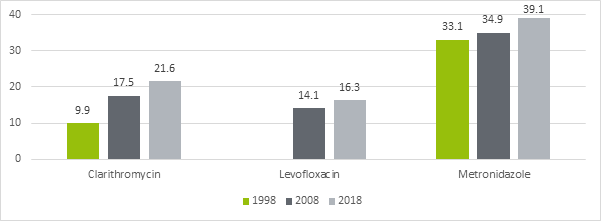
Evolution of primary antimicrobial resistance of H. pylori in Europe (1998-2018)2
Antibiotic resistance occurs when bacteria develop the ability to survive exposure to medications designed to kill or halt their growth. It is one of the greatest threats to global health today, causing more than 750,000 deaths every year3 and, without urgent action, this number is expected to rise dramatically in the future.
Presenting the study today, lead researcher Professor Francis Megraud, explained, “H. pylori infection is already a complex condition to treat, requiring a combination of medications. With resistance rates to commonly used antibiotics such as clarithromycin increasing at an alarming rate of nearly 1% per year, treatment options for H. pylori will become progressively limited and ineffective if novel treatment strategies remain undeveloped. The reduced efficacy of current therapies could maintain the high incidence rates of gastric cancer and other conditions such as peptic ulcer disease if drug resistance continues to increase at this pace.”
H. pylori is one of the most common bacterial infections in humans and is estimated to be present in one-half of the world’s population. H. pylori lead to inflammation of the stomach lining, namely gastritis, which can result in peptic ulcers. H. pylori is also the most important risk factor for gastric cancer, the seventh leading cause of cancer death in Europe and the third worldwide4,5. In recent years, H. pylori antibiotic resistance has become a prominent and urgent issue across the globe. Underlining the severity of the situation, in 2017, the World Health Organisation identified clarithromycin-resistant H. pylori as a high priority bacterium for antibiotic research and development6.
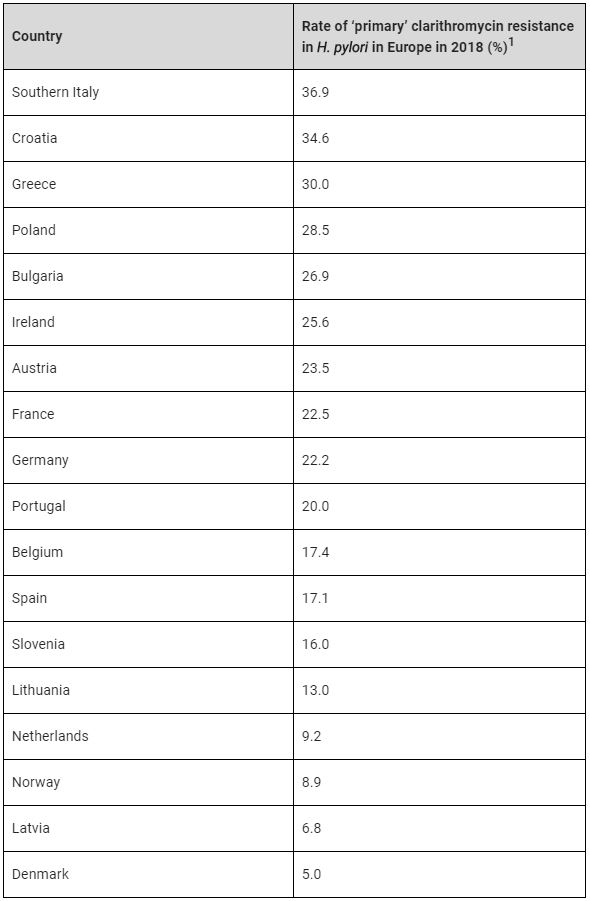
The survey also found that the rates of primary clarithromycin resistance in H. pylori were highest in Southern Italy (39.9%), Croatia (34.6) and Greece (30%), aligning with previous reports that predict that both Italy and Greece will have the highest number of deaths due to antimicrobial resistance amongst EU members by 20507. The high levels of resistance exhibited in these countries have been attributed to the overconsumption of antibiotics for conditions including cold and flu, and a lack of institutional support for antibiotic resistance containment strategies.
“The findings of this study are certainly concerning, as H. pylori is the main cause of peptic disease and gastric cancer,” commented Mário Dinis-Ribeiro, President of the European Society of Gastrointestinal Endoscopy. “The increasing resistance of H. pylori to a number of commonly-used antibiotics may jeopardize prevention strategies.”
Sources:
1. Megraud, F et al., 2019. European survey of Helicobacter pylori primary resistance to antibiotics – Evolution over the last 20 years. Presented at UEG Week Barcelona October 21, 2019
2. Glupczynski et al. EJCMID 2001, Megraud et al. Gut 2013 and Megraud, F et al., 2019. European survey of Helicobacter pylori primary resistance to antibiotics – Evolution over the last 20 years
3. ReAct AMR, The global threat of antibiotic resistance (ONLINE): Available at https://www.reactgroup.org/
4. European Cancer Information System (ECIS), Incidence and mortality 2018. (ONLINE). Available at: https://ecis.jrc.ec.europa.eu/
5. Rawla et al., 2018. Epidemiology of gastric cancer: global trends, risk factors and prevention. Available at: https://www.ncbi.nlm.nih.gov/
6. World Health Organisation, WHO publishes list of bacteria for which new antibiotics are urgently needed. (ONLINE). Available at: https://www.who.int/news-room/
7. OECD. Stopping antimicrobial resistance would cost just USD 2 per person a year. (ONLINE) Available at: https://www.oecd.org/newsroom/
m